Author: Harry Busz

  • Observation Groups: A quick overview

    Observation Groups: A quick overview

    As we often discuss, in recent decades election observation has become crucial to improving democracy and promoting human rights across the globe. Not only does it help improve electoral systems by review, it also dissuades electoral fraud, promotes public confidence in the electoral process, and produces more valid elections. Since the first monitored plebiscite took place in modern day Romania in 1857, the practice has grown as a way of legitimising and improving elections, especially since World War II and increasingly since the end of the Cold War. One of the aspects of domestic and international observation which can often be confusing, even after understanding more about observation, is knowing which groups carry out the practice. Perhaps it’s just the endless abbreviations or maybe the cross-over between these groups work, but I thought it may be a good idea to highlight the main organisations operating in the field.

    European Union/ EU EOMs

    Every year the European Union spends thirty-eight million Euros conducting around ten observation missions to third countries in regions such as Africa, the Middle East, Asia, Latin America and the Caribbean. This is done to reflect the EU’s ‘commitment to supporting democracy and promoting human rights around the world’ with a focus on fragile and developing states. These observations include a mixture of Long-Term and Short-Term Observers and helps increase public confidence and promote participation in elections whilst reducing the chances of election related conflicts occurring. This is reflected in the following report produced, which provides not only suggestions on how to improve the integrity of future elections but also the wider process of democratisation. The EU does not observe elections within EU states – those are conducted by…

    Organisation for Security and Co-operation in Europe/ ODIHR

    The OSCE is an inter-governmental organisation, with member states present across Europe, central Asia and North America with a focus on improving security through human rights, arms control and freedom of the press. In addition to this, the Office for Democratic Institutions and Human Rights (ODIHR), a branch of the OSCE, is responsible for promoting democratic elections in the member states judging their elections for their ‘equality, universality, political pluralism, confidence, transparency and accountability’. In recent years observations have moved away from emerging democracies towards more established ones in an attempt to scrutinise the role of technology in elections and the rise of early and postal voting. Unlike the EU it only observes elections within the member states of the OSCE.
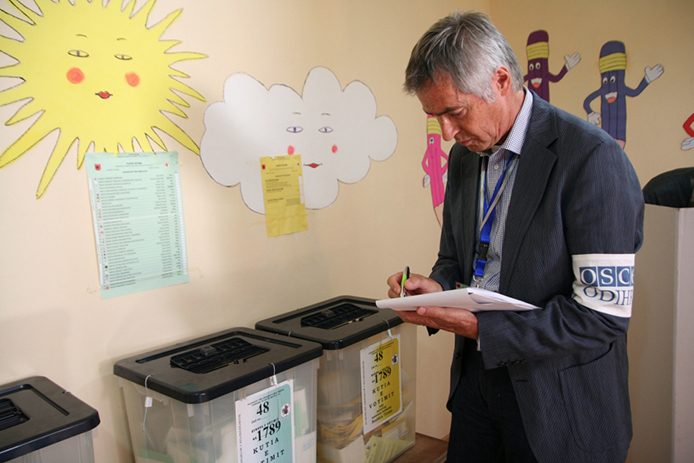
    An observer representing the ODIHR

    Council of Europe

    Often confused with the European Union, in my case due to the then European Communities adoption of the council’s flag in 1985, the Council of Europe is advised by the Venice Commission (comprised of independent experts in constitutional law) and aims to protect voters rights and enhance the capacity of national electoral stakeholders. In addition to training domestic observers, the Division of Electoral Assistance helps national election administration, encouraging voter participation and shift electoral legislation.

    UNEAD

    The United Nations Electoral Assistance Division has recently scaled back the number of election observation missions it undertakes following the practice’s widespread use in the 1990s. At this time following decolonisation and the shifting of electoral responsibility to newly democratised countries, the organisation oversaw landmark elections in nations such as Timor-Leste, Cambodia and El Salvador. In some transitional cases, such as the former, the UN has been fully responsible for the organisation and conduct of the whole election in order to provide the result validity and encourage a peaceful election. In more recent times assistance has been provided to through technical and logistical assistance in Afghanistan, the Democratic Republic of Congo and Iraq, although gaining this assistance requires a mandate from the General Assembly or the Security Council limiting their number, often under the banner of peacekeeping or as special political missions. In total over 100 member states have been assisted across over 300 elections and plebiscites, though much of their work has overseen broader issues than other organisation’s observation missions.

    Domestic Groups

    The final group to discuss is that of domestic electoral groups.

    These groups are generally part of the Global Network of Domestic Election Monitors (GNDEM) which currently comprises of 251 organisations in 89 countries and territories. These groups differ significantly from the others mentioned as they are a direct way for citizens to be involved easily in electoral observations and scrutinise the democratic process which protects the rights of people ‘to participate in electoral and political processes’. Non-partisan observers will often visit a larger amount of polling stations compared to intergovernmental organisations, providing a wider understanding of election day activities through data collected from activities occurring in polling stations such as disabled access, family voting and of political actors in the polling stations vicinity.

    Of course, this list is not exhaustive and other groups do exist across the world, for example regional organisations such as the Arab Network for Democratic Elections and the East and Horn of Africa Election Observers Network operate as members of GNDEM, carrying out vital work in these regions.

    There are then, many observation organisations operating across the globe, from smaller citizen led observation groups to those run by the biggest intergovernmental organisations. Their rapid spread since the 1990s has demonstrated an increased will from nations, international organisations and citizens to promote the spread of democracy across the world and enhance it at home.

    Harry Busz is editor of The Election Observer
  • What Observers look for: Family Voting

    What Observers look for: Family Voting

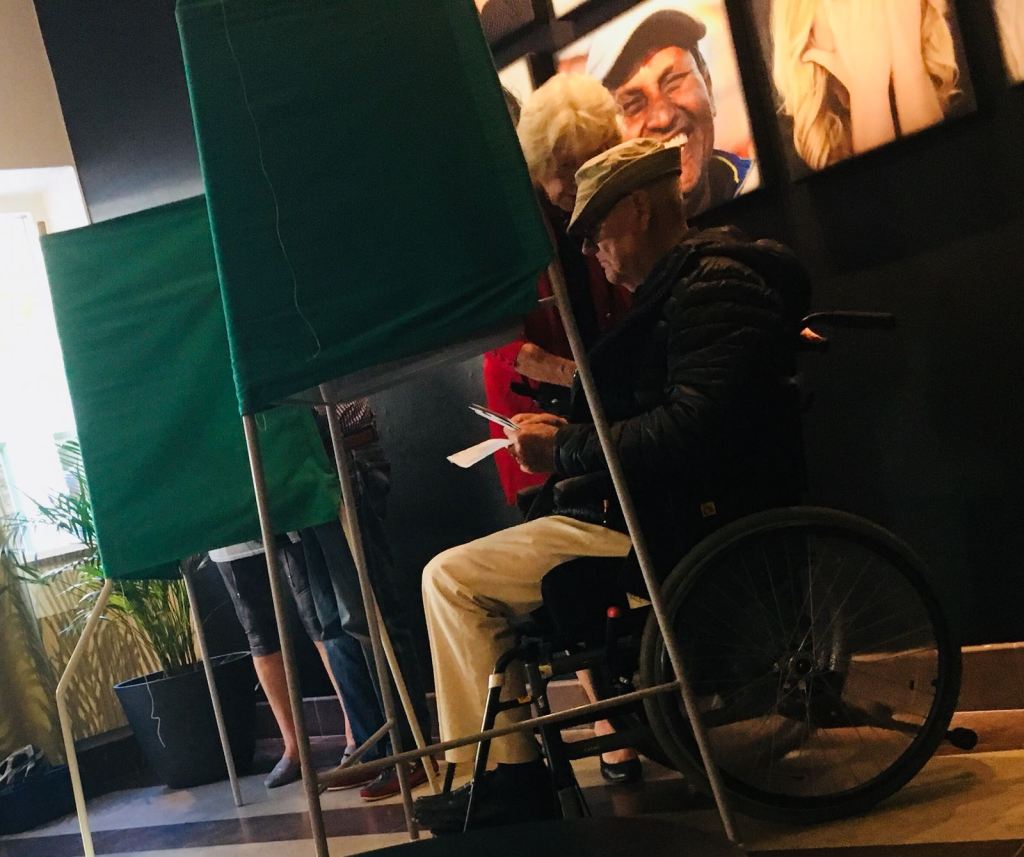
    Family voting, also referred to as group voting, is one of the most common issues that observers encounter in polling stations. For example, during two recent Democracy Volunteers observations in Northern Ireland and The Netherlands the violation was witnessed in 44% and 11% of polling stations monitored respectively (Democracy Volunteers, 2019a & b). But what is family voting and why does it matter?

    What Is it?

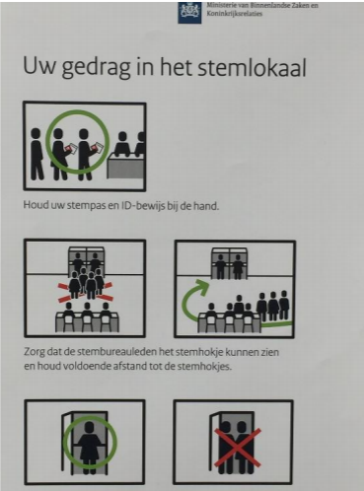
    Family voting is defined by the OSCE as ‘Where more than one voter is present in a polling booth or behind a voting screen at the same time. The term “family voting” is sometimes used even though it is not always the case that a group of voters are members of one family’ (OSCE/ODIHR,2010). It can take a variety of forms such as two voters entering a single polling booth to cast their ballot, to talking in a queue whilst waiting to vote. During observations it is not extremely rare to witness a (literal) whole family of four or five voters deciding on a candidate at the polling booth together or for a parent to physically mark a ballot belonging to their adult children or partner. Many participants do not know what they are doing is against electoral law and polling staff are often too busy, distracted or intimidated to intervene. In order to dissuade the practice voters are often presented with a poster as can be seen in the photo below although these are not a necessity in many elections.

    A poster used to prevent family voting in the Netherlands

    Why is it important?

    The main issue surrounding family voting is that it prevents the right for a voter to cast a secret ballot in line with paragraph 5.1 of the Copenhagen Document’s commitments (CSCE, 1990). This is a fundamental right for voters as it protects their political privacy reducing the chances of intimidation and blackmail, ensuring their free expression of opinion increasing the validity of the vote.

    The practice is seen to disproportionately effect certain groups of voters, such as first-time voters, non-native speakers and women. As described by a National Democratic Institute and iKNOW report (2009), women’s voting rights are especially at risk in communities where social and cultural voting norms are dictated by a history of male family heads deciding which political candidate will gain a group/family’s support. First-time voters are also often witnessed family voting as they are unsure about the voting system and often seek assistance from those accompanying them, as may be voters who experience a language barrier. For this reason, it is especially important that these voters are helped to understand the process of voting by election officials, outside of the polling booth, with no chance for coercion.

    CSCE (1990) Document of the Copenhagen meeting of the conference on the human dimension of the CSCE. https://www.osce.org/odihr/elections/14304?download=true

    Democracy Volunteers (2019a) The Netherlands Final Report. https://democracyvolunteers.org/2019/05/16/final-report-netherlands-provincial-and-water-board-elections-20-03-19/amp/?__twitter_impression=true

    Democracy Volunteers (2019b) Preliminary Statement- Northern Ireland local elections 02/05/2019. https://democracyvolunteers.org/2019/05/04/preliminary-statement-northern-ireland-local-elections-02-05-19/

    NDI & iKNOW (2009) Consolidated response on the prevention of family voting. https://www.ndi.org/sites/default/files/Consolidated%20Response_Prevention%20of%20Family%20Voting.pdf

    OSCE/ODIHR (2010) Election Observation Handbook 6th edn. https://www.osce.org/odihr/elections/68439?download=true

    Harry Busz is editor of The Election Observer
  • Why election observation is crucial to a properly functioning democracy

    Why election observation is crucial to a properly functioning democracy

    Over the coming weeks we will bereleasing articles focussing on what election observation entails: whatobservers look for, why certain electoral laws are important, and how they canbe upheld. As a precursor to this though, I feel it is important to answer oneof the most frequent questions observers are asked, ‘Why do you do observation?’.

    The practice is not just one that isinitially confusing to friends and family in conversation, but even to electionofficials such as polling staff and returning officers. This is often reflectedby the befuddled looks observers get on their arrival at polling stations,which can on occasions worryingly lead to staff questioning their right toobserve.

    What is observation?

    “Establishing an election process that is open to citizen examination is essential because citizens not only have the right to genuine elections, they have the right to know whether the election process provided an opportunity for free expression of the will of the electors and accurately recorded and honored the electors’ will.” (GNDEM, p.2, 2012)

    Election observation/monitoring is a practice undertaken by an independent body, which assesses the standards, and therefore legitimacy, of an election. The scope of what is investigated can vary widely, often depending on the resources available to the NGO conducting the mission. Organisations which undertake observation range from large international institutions such as The Council of Europe and the OSCE/ODIHR to domestic observation groups such as Democracy Volunteers – the only such group in the UK and the largest in Western Europe of this kind. Work is undertaken before, during and after polling day itself, providing both a quantitative insight into polling activities as well as a more qualitative based assessment of national electoral processes and their delivery, campaigning and advanced voting to name some of the elements observed.

    Yet, it is important to note that observers do not intervene during an election. Instead they produce reports which are circulated to national governments and their related departments as well as being made publicly available displaying the issues found alongside recommendations for the future. All of these activities are approached from a completely non-partisan perspective and observation focusses on the electoral processes strengths and weaknesses rather than being concerned with the political outcome of any particular vote. This allows observation organisations a degree of legitimacy in assessing an election which could not be gained from a national government which could have inherent bias.

    The amount and scope of election observationsrose rapidly during the late 1980s and throughout the 1990s, as newlydemocratizing states wished to prove they could gain democratic maturity at atime where an evolving set of norms were emerging ‘related to democracy, electionsand human rights’ (Kelly, 2008, p.225). Thus, it allowed states to gainlegitimacy and was soon institutionalised at this crucial time as refusingobservers became a costly act due to international pressure and the associated ‘stampof illegitimacy’ that accompanied it (Kelly, 2008, p.246). It also acted as amechanism to aid states in improving their elections through independent analysis.

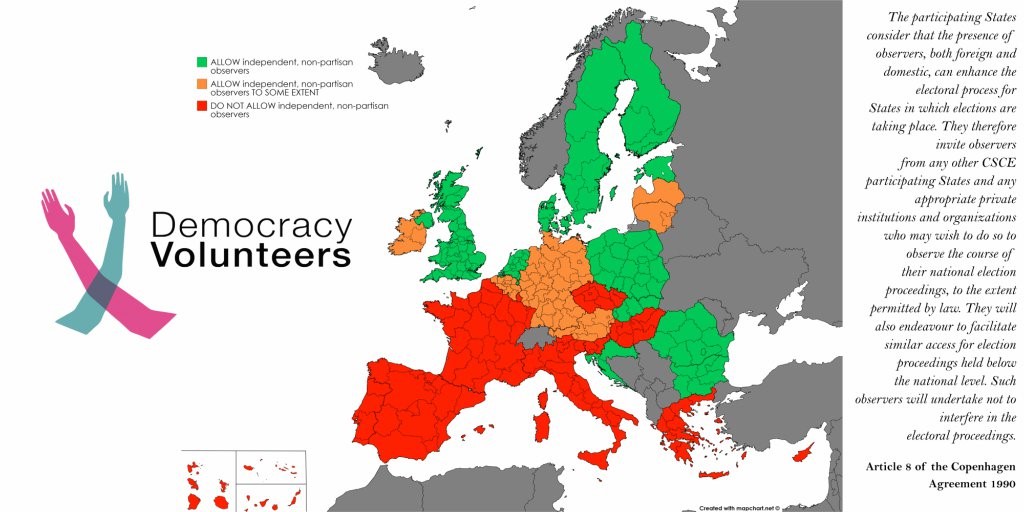
    However, it is not only emerging democracies that have started to invite observers and embraced the process. For well-established Western Democracies, observation can be seen as setting the precedent for well run elections with the aim to keep improving their electoral system (as even in many states perceived to have top class democracies, many issues are often identified). These can relate to multiple steps of the electoral process and specific issues that are encountered regularly will be explored in this following series of articles which often relate to accessibility for all citizens, the security of the secret ballot and the successes/failures of experimentation with the process like voter ID trials and electronic voting to name only a few. For this reason, unimpeded access for observers is crucial and recent developments relating to this have been worrying (See map above).

    Why do observation?

    Observations allow citizens to interact with the electoral process, allowing for scrutinisation and the enhanced transparency of elections. As such it is vital that citizens engage with this opportunity in order to protect and enhance democracy and our human rights. Aside from this, it is a great way to learn more about politics and get involved with the procedure of elections, from a non-partisan viewpoint, enhancing one’s understanding of the world around. If you would like to learn how to get involved in an observation mission visit https://democracyvolunteers.org/vacancies/ for more information.

    Harry Busz is editor of The Election Observer
  • My first election observation

    My first election observation

    image
    EnterOne of the prettier polling stations we observed at in Woking a caption

    I recently conducted my first election observation with Democracy Volunteers, at this month’s local elections in Woking. What made this observation particularly interesting was that it was one of the councils trialing new Voter ID pilots which had also been rolled out in some instances (including Woking) in 2018. I will give my verdict on the successes and failures of the ID trials later on.  I found the observation provided an interesting contrast to the Exit Polls work I had been involved in whilst at the University of Exeter, for a research project on the 2015 General Election.

    The first thing to note about election observation is that it is a long day. I woke up at 5:30 for a 7 O’clock start and we finished around 10p.m. The size of the Woking borough is large and so it was a very fast paced day and between a group of four observers, we managed to cover over 30 of Woking’s 43 Polling stations, including those in neighbouring towns of West Byfleet, Byfleet and Pyrford. The staff in almost all of the Polling stations were very welcoming, providing observers with refreshments as well as information on how the ID trials had gone for the polling station in question. Throughout the course of our observation we saw few people turned away because they had forgotten their ID and it appeared that the vast majority of those who were turned away, were able to return to vote at a later point in the day.

    My main thoughts on the ID trials were that they appear to have largely been a success, with the need for ID incredibly well advertised at each of the Polling stations visited as well as throughout the town including at the train station. The majority of those we saw turned away appeared to be older voters, who had not had to produce ID in the past. This will obviously be an issue which needs to be examined before the trials are rolled out on a wider scale, as older voters traditionally vote in far larger numbers than any other demographic, and as such it is important they are not disproportionately affected by any newly proposed Voter ID laws.

    Overall this was a great first-time observation and has given me a strong urge to conduct further observations in future. It is also convenient that the EU elections are taking place just 3 weeks after the Local Elections which I am looking forward to greatly.

    Chris Connor is a recent graduate from Exeter University where he gained a Master’s degree in International Relations.